
The State of Prop Firm Challenges 2026: What 64 Firms Actually Cost, Pay, and Require
We analysed pricing, profit splits, evaluation models, payout terms and platforms across all 64 firms in the PropFirmPickr database. The one-step challenge is now the default, entry prices have collapsed below $50, and two-thirds of firms pay out in crypto.
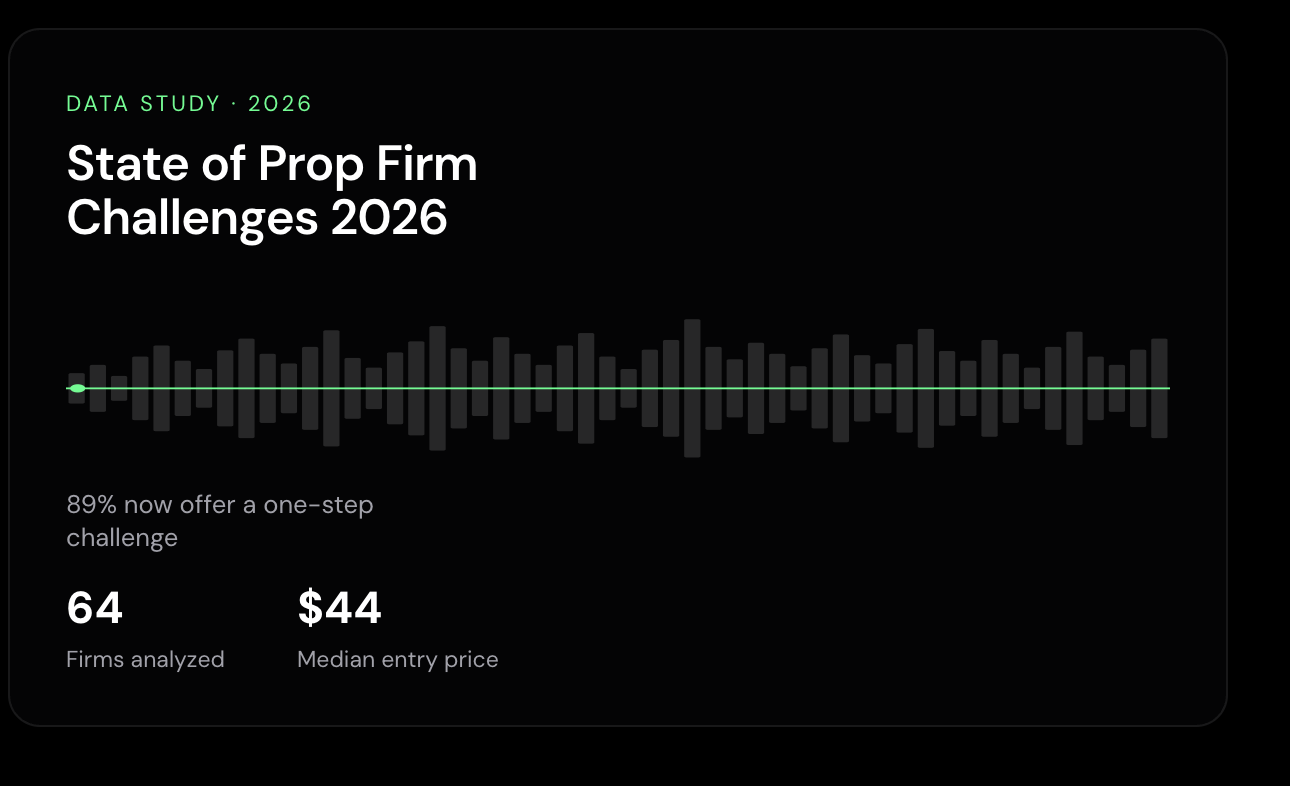

The prop-firm industry reinvents itself every 18 months. To cut through the marketing, we pulled the raw numbers on every firm we track: pricing, profit splits, evaluation structure, payout terms, headquarters and trading platforms. Then we looked for what has actually changed. This is a data study of all 64 firms in the PropFirmPickr database as of July 2026, not a survey of opinions.
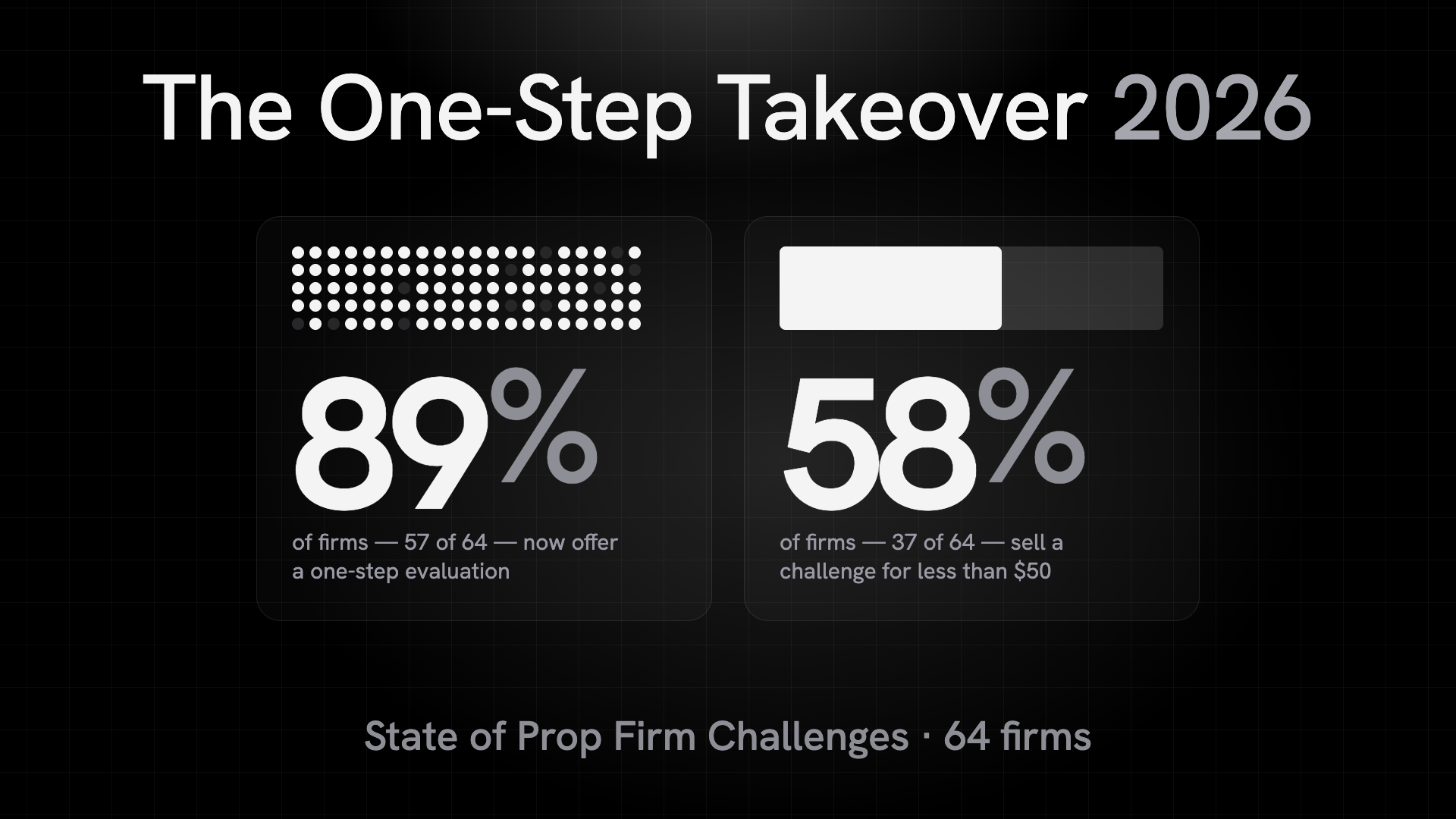
- 89% of firms (57 of 64) now offer a one-step evaluation. The single-phase challenge has overtaken the classic two-step as the industry default.
- $44 is the median cheapest entry across all firms. 37 firms have a challenge priced under $50, and a handful run promo entries as low as $1.
- 80% is the baseline profit split, offered by 21 firms. 13 firms advertise 90% or higher.
- 67% of firms (43 of 64) support crypto payouts. It is no longer a niche feature.
89% of prop firms (57 of 64) now offer a one-step evaluation, making the single-phase challenge the industry default in 2026.
PropFirmPickr · State of Prop Firm Challenges 2026The one-step challenge is now the default
For years the two-step evaluation, a Phase 1 profit target followed by a Phase 2 verification, was the standard. In 2026 that is no longer true. Of the 64 firms we track, 57 offer a one-step path to funding, more than the 37 that still run a two-step, and 34 now offer an instant-funding or no-evaluation product as well. Most firms offer several models side by side.
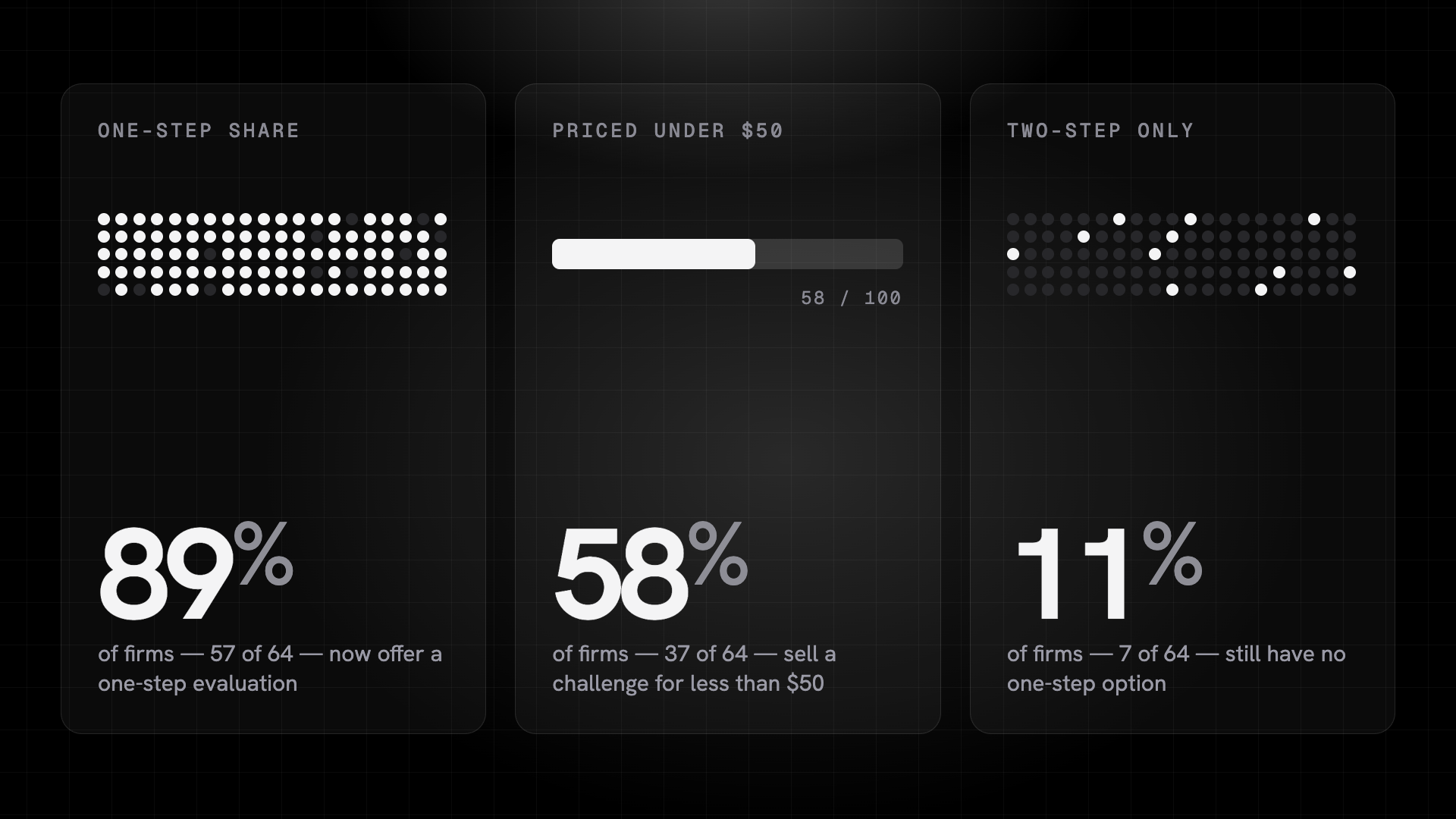
The shift is a direct response to trader demand. A single phase gets you to a funded account faster and removes the "passed Phase 1, failed Phase 2" frustration that dominated 2023 and 2024. If you want to compare the two structures in detail, our guide on 1-step vs 2-step evaluations walks through the trade-offs, and no-evaluation firms lists the instant-funding options.
The price of entry has collapsed
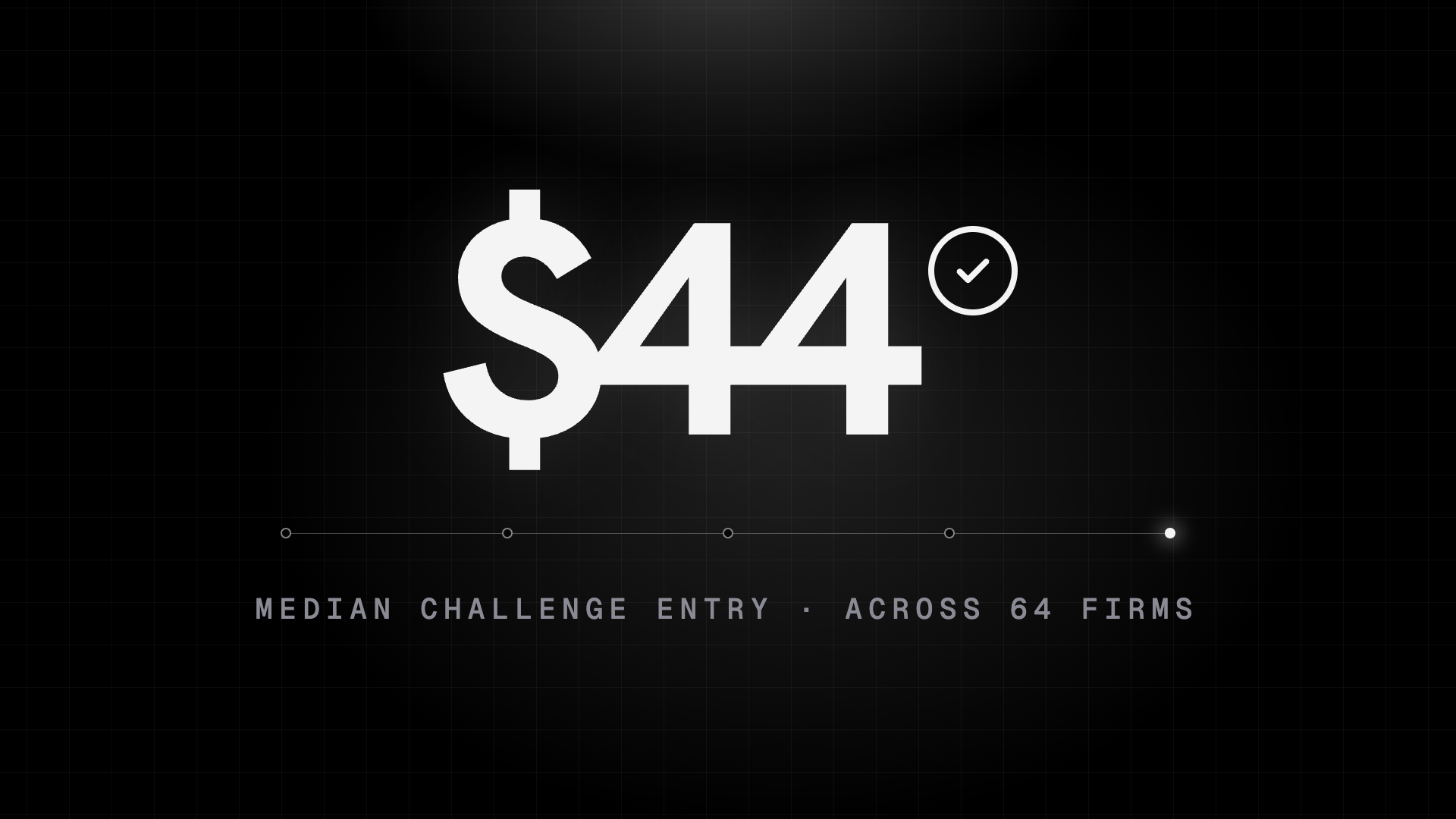
Entry pricing has fallen off a cliff. The median "cheapest available challenge" across all 64 firms is just $44, and more than half of all firms now have at least one challenge priced under $50. The lowest entries, the $1 and $5 promotional accounts, are loss-leaders designed to get you in the door. But the broader trend is real: the cost of attempting funding has never been lower.
Key takeaway
A low entry fee is not the same as good value. A $5 challenge with a trailing drawdown and an 80% split can cost you far more in failed attempts than a $150 challenge with a static drawdown and a 90% split. Price is a starting filter, not the decision. See our cheapest firms under $100 breakdown for the ones that are actually worth it.
Profit splits: is 80% the floor or the ceiling?
The profit split, the share of trading profit you keep, has settled into a clear band. Among the 57 firms that publish a headline split, 80% is by far the most common, offered by 21 firms. Thirteen firms advertise 90% or higher, and a small group promote "up to 100%" arrangements, usually tied to a scaling milestone or a first-payout promotion rather than a permanent rate.
Headline profit split, number of firms (of 57 reporting)
The practical read: anything below 70% is a relic, 80% is table stakes, and 90% should be reachable through a scaling plan. Be sceptical of a flat "100%" headline. The money is always made back somewhere, whether in the challenge fee, the payout cadence, or the rules.
Payouts have gone crypto
The clearest infrastructure shift is in how traders get paid. Two-thirds of firms (43 of 64) now support crypto payouts, typically USDT or USDC alongside traditional bank transfer and Riseworks or Deel rails. For traders outside the US and EU banking systems, crypto payout support has quietly become one of the most important practical filters when choosing a firm.
The barrier to getting funded has never been lower. But a $5 entry and a 90% split mean nothing if you cannot read the drawdown rule.
Where are prop firms based?
Prop firms cluster in a handful of jurisdictions. The United States and the United Arab Emirates lead almost evenly, together accounting for nearly half of all firms we track, followed by the United Kingdom. Headquarters matters for two reasons: it shapes which countries a firm can legally serve, and it is a rough proxy for regulatory scrutiny.
| Headquarters | Firms |
|---|---|
| United States | 16 |
| United Arab Emirates | 15 |
| United Kingdom | 8 |
| Saint Lucia | 5 |
| Switzerland | 2 |
| Czech Republic | 2 |
Which platforms do prop firms support?
MetaTrader 5 remains the most widely supported platform, offered by roughly half of all firms, but its dominance is no longer absolute. cTrader, Match Trader and the newer TradingView and Tradovate integrations have carved out real share. That is a healthy sign that firms are competing on execution experience, not just price.
Trading platforms supported, number of firms (of 64)
What does the 2026 data mean for you?
Put together, the 2026 picture is a maturing, buyer-friendly market: cheaper to enter, faster to fund, paying larger splits through more payout rails, on more platforms. The catch is that the differences that actually decide whether you keep a funded account, the drawdown model, the consistency rule, the payout proof, are exactly the ones the marketing pages bury. Start with our firm matcher to narrow the field, then read the rules explainer before you pay for anything.
Frequently asked questions
What is the most common prop firm challenge type in 2026?
The one-step, single-phase challenge. 57 of the 64 firms we track offer one, which makes it the industry default. The classic two-step still exists at 37 firms, and 34 firms also sell instant-funding or no-evaluation products.
How much does a prop firm challenge cost on average?
The median cheapest challenge across all 64 firms is $44, and 37 firms have at least one challenge priced under $50. Promotional entries run as low as $1, but those are loss-leaders on tiny accounts, not a serious funding path.
What profit split should you expect?
80% is the baseline, offered by 21 of the 57 firms that publish a split. 13 firms advertise 90% or higher, usually unlocked through a scaling plan. Treat anything below 70% as outdated.
Do prop firms pay out in crypto?
Most do. 43 of 64 firms, about two-thirds, support crypto payouts such as USDT or USDC, alongside bank transfer and payment rails like Riseworks and Deel.
Where to go next
Turn the data into a shortlist with these next steps.
- Find my prop firm: filter the 64 firms by the rules that matter to you.
- How to pick a prop firm: the five-filter buying framework in full.
- Cheapest challenges under $100: the lowest entry prices from firms worth trusting.
- Prop firm rules explained: drawdown, consistency and payout rules in plain English.
- Profit calculator: model your payout and break-even before you pay.
Methodology
This study is based on the PropFirmPickr firm database: 64 prop-trading firms tracked as of July 2026, covering advertised pricing, profit splits, evaluation structure, payout methods, headquarters and supported platforms. Figures reflect each firm's publicly stated terms. Where a firm offers multiple products, we count each model or feature it advertises, so category shares can sum to more than 100%. Splits are counted only for the 57 firms that publish a headline figure. Pricing reflects the lowest listed challenge per firm at the time of collection and can change with promotions. We refresh this dataset continuously. The numbers above are a July 2026 snapshot.