
1-Step vs 2-Step Prop Firm Evaluations: Which Should You Pick?
1-step challenges are faster, 2-step challenges are cheaper. Here's the trade-off matrix every prop trader should run before signing up.
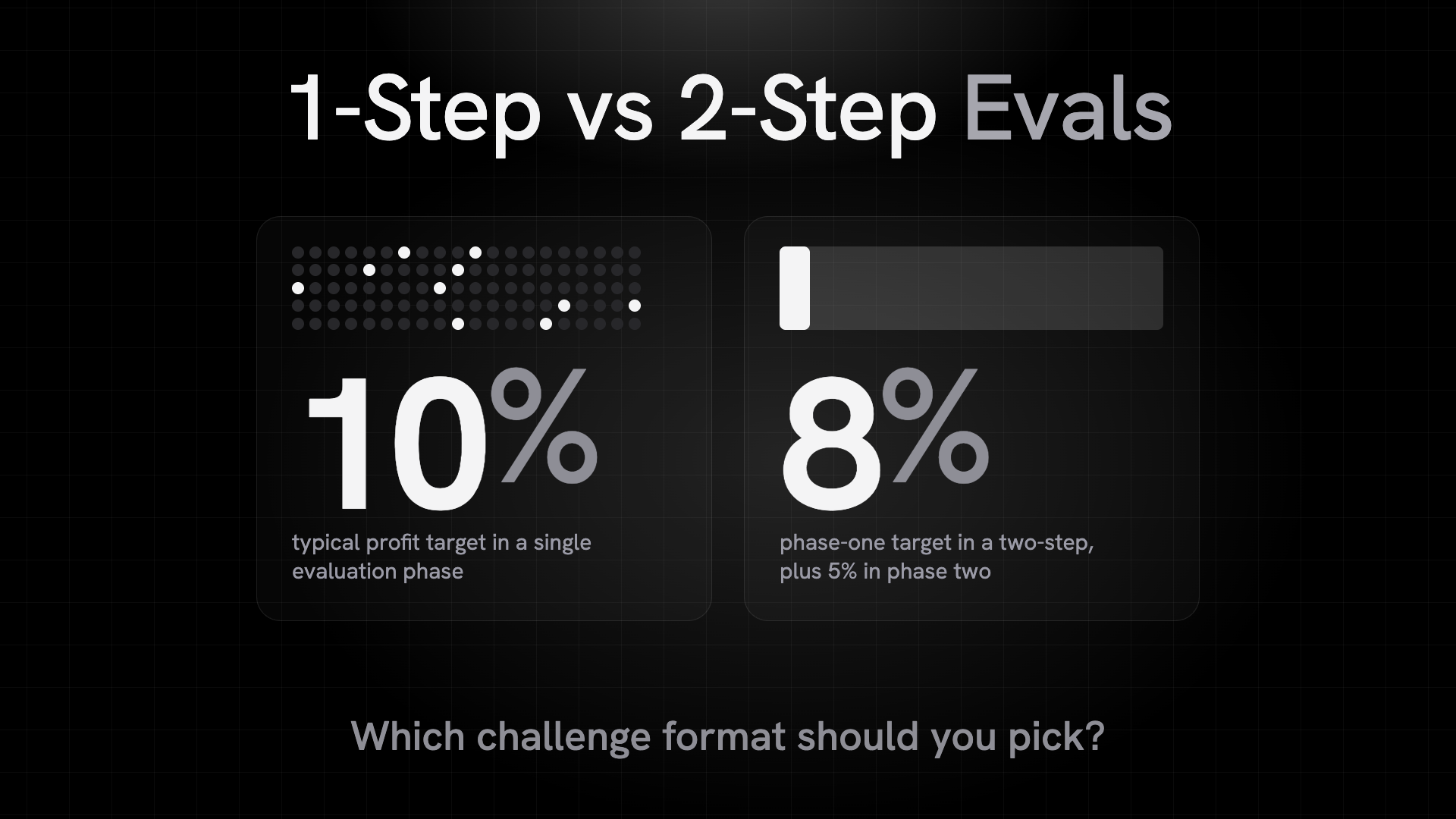

Both formats lead to the same funded account, but the path, cost, and rule set are very different. This guide shows you how to pick the right one, and why the cheaper option is not always the smart one.
Most traders choose between these two on price alone. That is a mistake. The real question is how long your edge holds up, not what the challenge costs on day one. Read on and you will know which format fits the way you actually trade.
The headline difference
Here is the full comparison at a glance. Every number below is typical for a standard $100K account. Individual firms vary, so treat these as the market average, not a promise.
| Dimension | 1-Step | 2-Step |
|---|---|---|
| Phases | 1 evaluation | Phase 1 + Verification |
| Profit target | 10% (single phase) | 8% + 5% (combined) |
| Average time to fund | 5-12 trading days | 15-30 trading days |
| Cost (typical $100K) | $799-$999 | $449-$549 |
| Daily drawdown | 4-5% | 4-5% |
| Best for | Confident scalpers, news traders | Swing traders, beginners |
Is a 1-step really faster?
Yes, and by a wide margin. A 1-step challenge asks for one profit target and then you are funded. There is no second gate to clear. Most traders reach a funded account in 5 to 12 trading days.
A 2-step challenge splits the work across two phases. You hit 8% first, then prove it again with 5% in a verification stage. That extra phase adds real calendar time, usually 15 to 30 trading days in total.
Speed is the whole appeal of the 1-step. If you want to be trading funded capital this week rather than next month, the single phase is the shorter road.
How each format feels to trade
The numbers only tell half the story. The two formats feel different once you are live.
A 1-step feels like a sprint. The 10% target is higher, so every trade carries more weight. There is less room to recover from a bad opening week. This suits traders who are sharp early and lose their edge over longer stretches.
A 2-step feels like a measured climb. The 8% first target is gentler, and the 5% verification is gentler still. You get two shorter runs instead of one long one. That rhythm rewards patience and punishes traders who force trades to catch up.
Which is easier to pass?
For most people, the 2-step is easier to pass. The targets are lower per phase, so you are not forced to push size or take marginal setups. The slower pace usually means a higher pass rate.
The 1-step is not harder because the rules are meaner. It is harder because the single 10% target leaves no second chance inside the same purchase. Miss your rhythm and you restart from zero.
If you have failed 1-step challenges before, that is a signal. A slower two-phase format often converts better for the same trader with the same edge.
Pick 1-step if…
- You have an edge that hits 10% reliably in 5-10 trading days.
- You are a scalper who cannot sustain edge over 30 days.
- You want to start trading funded capital this week, not next month.
- You can afford the higher evaluation fee.
- You trade news events and want to be funded before the next catalyst.
Browse 1-step prop firms.
Pick 2-step if…
- You are new to prop trading and want to learn the rule set across two phases.
- You prefer a lower up-front cost.
- You are a swing trader who works on multi-day timeframes.
- You have failed 1-step challenges before, since a slower pace usually means a higher pass rate.
- You want two shorter targets instead of one large one.
Browse 2-step prop firms.
What is the hidden cost most traders miss?
The sticker price is the wrong thing to compare. A 1-step at $799 to $999 costs more than a 2-step at $449 to $549. That gap looks decisive until you factor in resets.
If the faster pace makes you fail and rebuy, the cheaper-looking 1-step can end up costing more than a 2-step you pass on the first try. The true cost is the fee multiplied by the number of attempts you actually need.
Buy the format you can pass, not the one with the lower number on the checkout page.
There is also a time cost. A failed challenge is not just money. It is days you spend rebuilding instead of trading funded capital and collecting payouts.
Common mistakes to avoid
These are the errors we see most often when traders choose between the two formats.
- Choosing on price alone and ignoring your own pass history.
- Picking a 1-step when your edge only shows up over multi-day swings.
- Rushing a 2-step verification after a strong Phase 1 and giving the profit back.
- Treating the daily drawdown as a target instead of a hard limit. Both formats sit at 4-5%.
- Forgetting that the funded account, not the challenge, is where the money is made.
The hidden third option: instant funding
If both formats feel slow, instant funding skips evaluation entirely. You pay 4 to 6 times the fee, but you are trading funded capital the same day. It is only worth it if your edge is proven and your capital deployment timeline is tight.
For most traders this is a niche choice. The higher fee only pays off when speed itself has real value to you.
Can you switch formats later?
Yes. Nothing locks you into one format for good. Each challenge is a separate purchase, so your next attempt can be a different format at a different firm.
A smart path is to start where your odds are best, then adjust. Many traders learn the rules on a 2-step, build confidence, and later buy a 1-step once they trust their pace. Others go the other way after a fast 1-step fails.
Let your results pick the format. If you keep passing one and failing the other, the market is telling you which one fits.
Frequently asked questions
Is a 1-step or 2-step cheaper overall?
The 2-step has a lower sticker price, at $449 to $549 against $799 to $999. But the cheapest option is the one you pass with the fewest attempts, since every reset means paying again.
Do both formats have the same drawdown?
The daily drawdown is the same, at 4 to 5% for both. The difference is the profit target and the number of phases, not the risk limit you trade under.
Which format is better for beginners?
The 2-step is usually better for beginners. The lower per-phase targets give you room to learn the rules without forcing risky trades to hit an aggressive number.
Can I get funded in a week?
A 1-step can fund you in 5 to 12 trading days if your edge holds. Instant funding is faster still, but you pay several times the fee for that speed.
Where to go next
Run the math before you buy. Use the tools and lists below to match a format to the way you actually trade.
- Compare break-even time with our profit calculator. Input the same account size and monthly return, then weigh a $499 two-step against an $899 one-step.
- Browse vetted 1-step prop firms if speed is your priority.
- Browse vetted 2-step prop firms if a lower up-front cost and a steadier pace suit you.
- Consider instant funding only if your edge is proven and your timeline is tight.
- Read our 7-step playbook, since the techniques apply to both formats.