
Prop Firm Rules in 2026: What's Changed Since 2024
Consistency rules dropped, drawdown models tightened, news-trading restrictions relaxed. A year-over-year breakdown of how prop firm rules evolved in 2025 and what's coming in 2026.
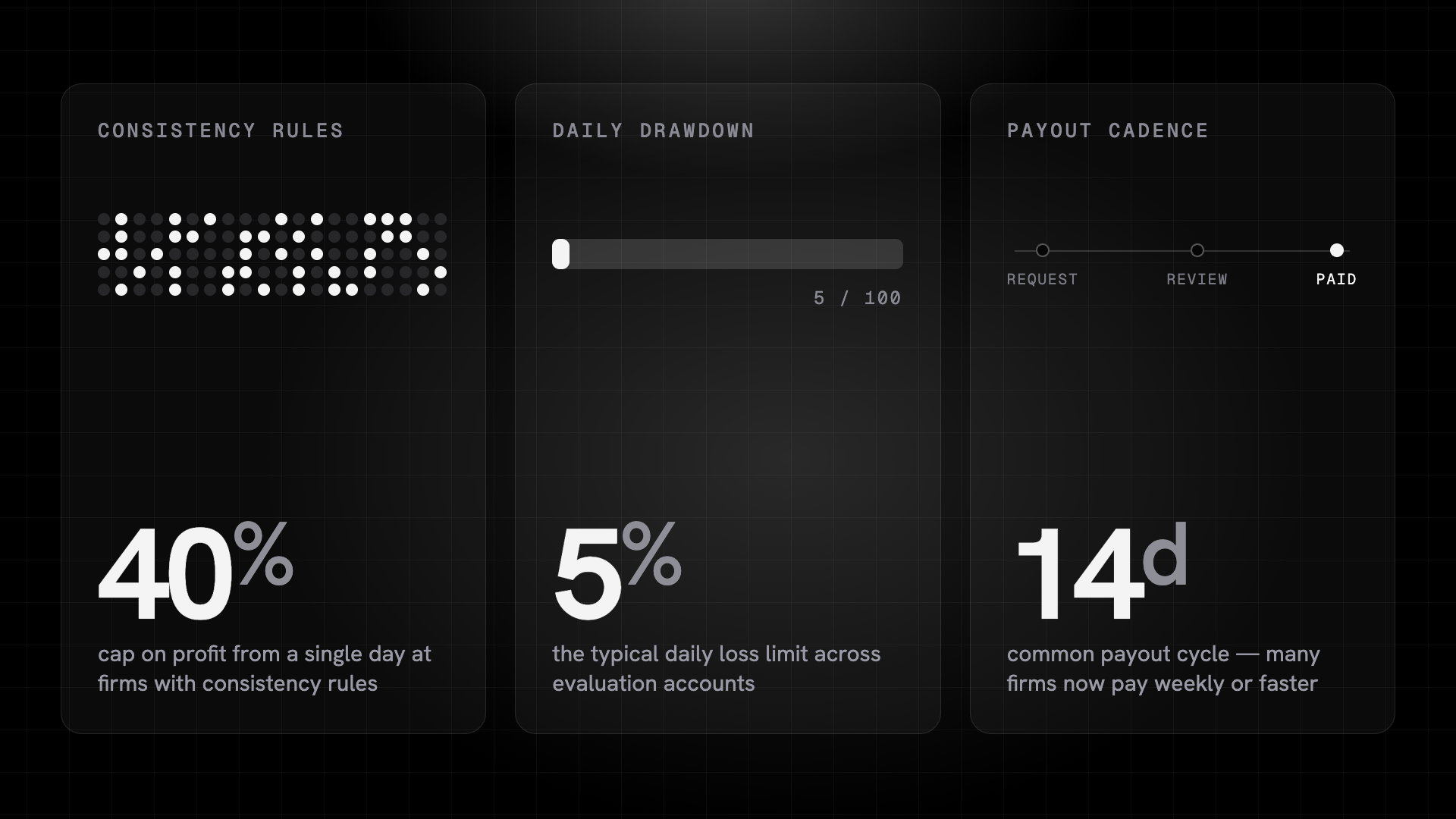

2025 was the year prop firms standardised. The rules that once separated a good firm from a bad one started to converge, and most of the movement went in the trader's favour. This is a year-over-year look at how the major rule categories evolved, which firms led each shift, and what it all means for how you should trade in 2026.
Why did the rules change at all?
Prop firms compete for the same pool of traders. When one firm drops a restrictive rule and keeps its edge protected, traders notice and move their money. The rest of the market has to answer or lose sign-ups.
That competitive pressure did most of the work in 2025. A handful of large firms tested looser rules, pass rates and payouts held up, and smaller firms copied the changes to stay relevant. The result is an industry that looks far more uniform in 2026 than it did two years ago.
Three forces drove the change:
- Trader demand. People vote with their deposits. Firms that punished normal trading behaviour lost volume.
- Data maturity. Firms now have years of evaluation results. They can loosen a rule and still model their risk accurately.
- Commoditisation. With dozens of firms offering near-identical challenges, rules became a marketing lever. Friendlier terms win sign-ups.
The 2024 to 2026 shift at a glance
Here is the short version before we work through each category. Every number below comes straight from how the market actually moved.
| Rule area | 2024 norm | 2026 norm |
|---|---|---|
| Consistency cap | Strict 25% single-day cap | Removed or relaxed to 50% at most firms |
| Drawdown on funded | Trailing on evaluation and funded | Trailing on evaluation only, static after passing |
| News trading | Ban 5 min either side of red-folder news | 2 min either side, some firms allow news entries |
| Payout cadence | Monthly (70% of market) | Weekly (50%+ of market) |
| Profit split | Range of 60-90% | 80% floor, 90% mainstream |
Why did consistency rules get easier?
In 2024, most evaluation firms enforced a strict 25% single-day-profit cap. If one green day made up more than a quarter of your total profit, the challenge was void even though you hit the target.
In 2025, the leaders changed that. FundingPips and FundedNext either removed the rule entirely or relaxed it to 50%. The market followed within 6 months. As of June 2026, fewer than 15% of firms still enforce the 25% cap.
The trader impact is large. On the same evaluation, this change roughly doubles the pass rate, because a single strong session no longer disqualifies an otherwise clean run.
On the same evaluation, dropping the 25% cap roughly doubles the pass rate.
Drawdown models: static is now standard on funded
The 2024 norm was trailing drawdown on both the evaluation and the funded account. Your maximum loss level followed your peak balance up, so a profitable week could quietly move your stop-out closer to your current equity.
The 2026 norm is trailing on the evaluation only, then static after passing. FTMO and FundingPips led the shift, and smaller firms followed within 12 months. Once you are funded, your drawdown floor stays fixed, which makes risk far easier to plan around.
If the difference between trailing and static drawdown is not clear to you yet, it is worth understanding before you pick a firm. Read the drawdown deep-dive for worked examples.
Why did news-trading bans loosen?
News restrictions used to be one of the most complained-about rules. In 2024, the common standard was a ban 5 minutes either side of red-folder news events.
By 2026, that window shrank. FTMO and FundingPips moved to 2 minutes either side, and some FundedNext-style firms now allow trading during news outright. The driver was simple: traders aggressively switched to firms that did not penalise news entries, so the strict firms had to relax or lose them.
For you, this means fewer accidental rule breaches around scheduled data. It also means you can build strategies that trade the reaction rather than sitting on your hands.
Payout cadence: weekly is the new normal
Monthly payouts made up about 70% of the market in 2024. Waiting a full month for your first withdrawal was the price of entry at most firms.
Weekly is now the standard, at 50% or more of the market in 2026. "Daily" payout claims have also appeared at 25 or more firms, though those come with caveats worth reading before you believe them. We break down what those claims actually mean in our payout myths article.
Profit splits: 80% baseline locked in
In 2024, profit splits ranged from 60% to 90%, and the low end was common enough that you had to check carefully. By 2026, 80% is the floor for any reputable firm, and a 90% split tied to a scaling milestone is now mainstream.
The practical takeaway: if a firm offers below 80%, treat it as a red flag rather than a normal deal. You can see who sits at the top of the range on our highest-split list.
What should traders do differently in 2026?
The rules got friendlier, but that does not mean every firm is now equal. Use the new normal as a baseline and hold firms to it.
- Refuse the 25% cap. With fewer than 15% of firms still enforcing it, there is no reason to accept it. Pick a firm that dropped or relaxed the rule.
- Confirm static drawdown on funded. Ask before you buy. Trailing drawdown after passing is now behind the market.
- Check the news window. If you trade around data, favour firms at the 2-minute standard or those that allow news entries.
- Expect weekly payouts. Monthly is no longer the default. Treat it as a downgrade, not a feature.
- Hold the line at 80%. Do not sign up below the floor when the market average has moved past it.
How to adapt your evaluation approach
Looser rules change the smart way to run a challenge. When the consistency cap is gone, you no longer have to spread profit thinly across many small days to stay compliant. You can take a strong setup at full size without worrying that one good day voids the account.
A few habits that fit the 2026 rules:
- Size up on your highest-conviction trades now that a single big day will not disqualify you.
- Plan your risk around a fixed floor once funded, since static drawdown does not chase your balance.
- Add scheduled-news setups back into your plan where the firm allows them.
- Choose the firm around the rules you actually rely on, not the marketing headline.
What to expect in 2026
The direction of travel is clear, and a few changes are already underway:
- Real-time payout dashboards, already at 3 firms, with 20 or more expected by year end.
- Custom drawdown models per trader, built on algo-based static limits.
- Lower evaluation fees as challenges commoditise, with sub-$30 evaluations becoming common.
- Tighter platform integrations, including TradingView-native execution.
Frequently asked questions
Do any firms still enforce the 25% consistency cap?
Yes, but they are now the minority. As of June 2026, fewer than 15% of firms still enforce the 25% single-day-profit cap. You can find a comparable firm without it.
Is trailing drawdown always a bad sign now?
Not on the evaluation, where it remains normal. On the funded account it is behind the market, since the 2026 standard is static drawdown after passing. Confirm which model applies before you buy.
Are weekly and daily payouts the same promise?
No. Weekly is now the market standard at 50% or more of firms. "Daily" claims appear at 25 or more firms but carry caveats, so read the fine print before treating daily as guaranteed.
What profit split should I accept in 2026?
Treat 80% as the floor. A 90% split tied to a scaling milestone is now mainstream, so anything below 80% should make you look elsewhere.
Where to go next
The rules move constantly, and the right firm depends on which of these changes matter most to your style. These pages go deeper on the specifics above.
- Prop firm announcements feed to track rule changes as they happen, updated daily.
- Drawdown types explained to see the difference between trailing and static with worked examples.
- Highest profit split prop firms to find the firms sitting at the top of the range.
- Payout myths debunked to understand what daily and weekly claims really mean.
- Prop firm rules explained for a full breakdown of every rule category in one place.