
How to Pick a Prop Firm in 2026: A Trader's Buying Guide
Five filters every retail trader should run before paying for a prop firm evaluation in 2026: profit split, drawdown model, payout cadence, rule clarity, and verified payout proof.
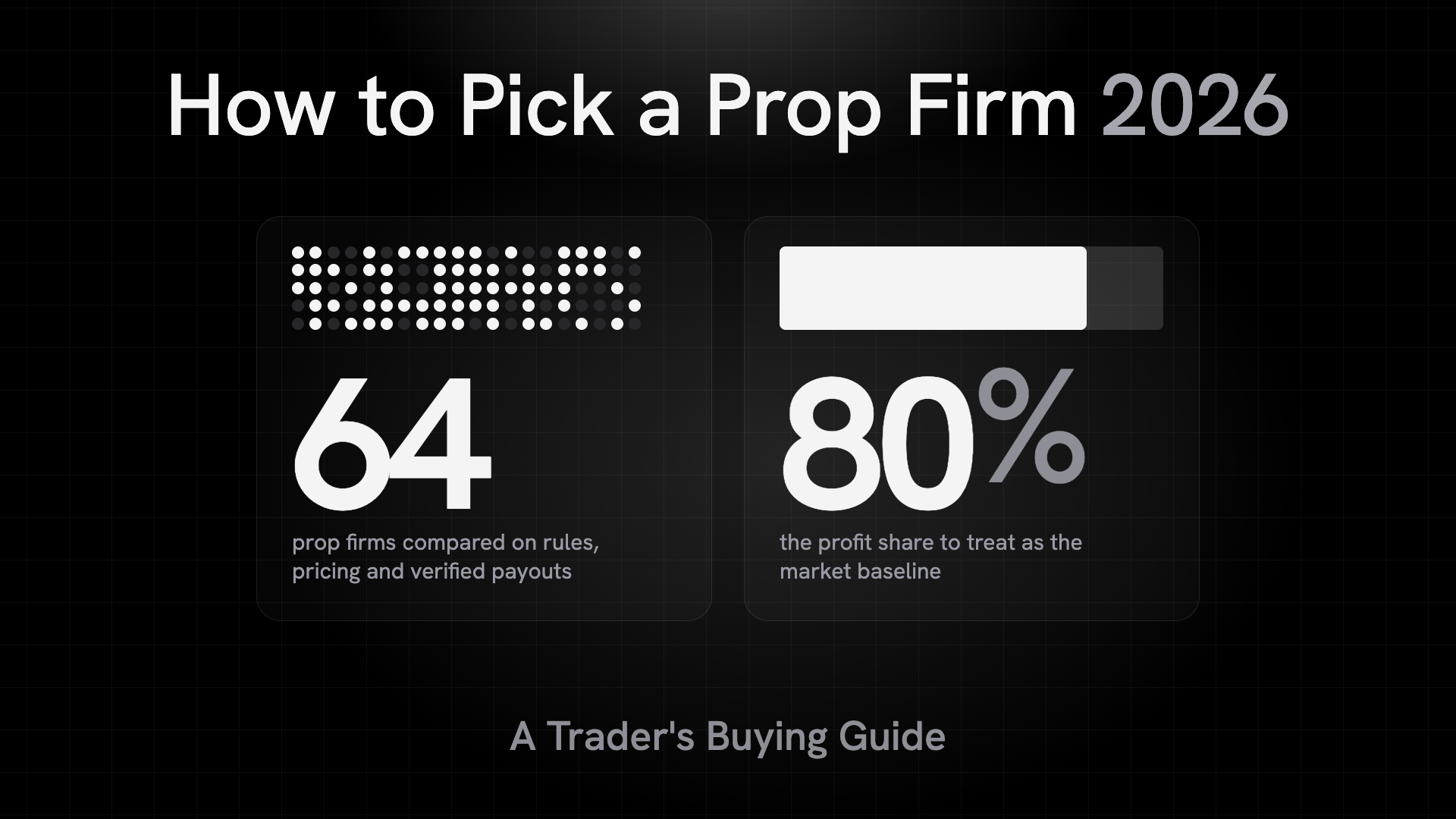

There are 200+ prop firms competing for your challenge fee, and their landing pages all read the same: big split, low price, fast payouts. The differences that decide whether you ever see a payout live in the rules. After tracking pricing, rules and payout terms across the 64 firms in the PropFirmPickr database, we know exactly where to look. Five filters, sixty seconds each. Run them in order and most firms eliminate themselves.
The order matters. Each filter below is meant to disqualify firms quickly, so you spend real time only on the handful that survive all five. Here is the short version before we go deep:
- Profit split. Is the split high enough, and does it cost you elsewhere?
- Drawdown model. Static or trailing, and does that match how you trade?
- Payout cadence. How often can you actually withdraw, not just in theory?
- Rule clarity. Can you find the rules that fail accounts in under 90 seconds?
- Verified payout proof. Are there receipts, or only testimonials?
Why does the profit split come first?
Start with the split, because it compounds. On a $100K account returning a modest $5,000 month, an 80% split pays you $4,000 and a 90% split pays $4,500. That $500 monthly gap is worth roughly ten challenge fees a year. The evaluation fee is the cheapest part of this decision.
In our database, 80% is now the unambiguous baseline. Of the 57 firms that publish a headline split, 21 sit exactly there, and 13 advertise 90% or higher. Those higher numbers are almost always unlocked through a scaling plan rather than on day one. Treat anything below 70% as a relic of the 2021 launch era.
Be suspicious in the other direction too. A firm advertising 95-100% with no scaling milestone has to recoup that margin somewhere, and it is usually slower payouts, pricier resets, or stricter rules. Start from the highest profit-split list, then check what the split costs you in rules.
Static or trailing: which drawdown model should you trust?
Nothing ends more funded accounts than the drawdown model, and no rule is buried deeper in the FAQ. There are two kinds, and they behave very differently.
- Static drawdown fixes your loss floor at the starting balance. A $100K account with a 10% static limit has a $90K floor on day one, and the same $90K floor after your best month ever.
- Trailing drawdown moves the floor up with your equity peak. Take the same account with a 5% trailing limit, trade it up to $104K, and your floor is now $99K. A routine $5,200 pullback that a static account shrugs off has just terminated yours, open profit included.
Trailing is not automatically a scam. It is how firms afford $44 evaluations. But it changes how you must trade. Taking partial profits stops being optional, overnight holds carry rule risk on top of market risk, and adding size mid-drawdown is account suicide.
If your plan is to hold six-figure funding for years, static is the gold standard and worth paying more for. Our drawdown deep-dive runs the exact math on $100K accounts.
What does "daily payout" actually mean?
Payout frequency is where marketing and reality diverge fastest. "Daily payouts" is technically true at several firms and practically irrelevant. Consistency rules and minimum trading-day requirements mean you cannot withdraw daily anyway. What actually matters is the reliable cycle.
| Advertised cadence | What it means in practice |
|---|---|
| Daily | A headline. Consistency rules block daily withdrawal for most traders. |
| Weekly | The sweet spot for active traders: realistic and cash-flow friendly. |
| Bi-weekly | The industry norm. Perfectly fine if the firm pays on schedule. |
| Monthly | Lagging the market in 2026. Ask what else is behind the curve. |
One more filter quietly outranks the split for many traders. 43 of the 64 firms we track, two-thirds, now pay in USDT or USDC alongside bank transfer. If you trade from outside US or EU banking, crypto payout support is the difference between money in days and money in weeks. The payouts leaderboard shows who documents their payouts with receipts.
Can you find the rules in 90 seconds?
Vague rules, not losses, are the number one source of funded-account terminations. Four policies decide most of them:
- The consistency rule, often a cap of around 40% of total profit from a single day.
- The news-trading policy.
- The expert-advisor (EA) policy.
- The weekend-hold policy.
The 90-second test
Open the firm's website and find all four policies: consistency, news, EAs, weekend holds. If you can locate them in under 90 seconds, the firm is transparent. If they are buried, vague, or split across a Discord FAQ, walk away. Ambiguity always resolves in the firm's favor, after you are funded. Our rules explainer covers every rule type and which firms document them cleanly.
Proof, not testimonials
Testimonials are marketing. Receipts are evidence. Real proof looks like a running payout total, a monthly payout count, a median time-to-payout, and named-trader case studies with actual amounts.
Our ranking methodology weighs payout reliability at 25% of the total score, heavier than price, for a simple reason: a 90% split at a firm that stalls withdrawals is 90% of nothing.
The challenge fee is the cheapest thing you will ever pay a prop firm. The expensive part is choosing one whose rules you didn't read.
Which signals should you ignore?
Just as important as the five filters is what not to weigh. These headline numbers feel like quality signals, but none of them predict whether your withdrawal arrives:
- Account-size headlines. "Get funded up to $4,000,000" is marketing. Scaling plans gate those numbers behind months of consistent profit, and almost nobody reaches them.
- Trustpilot averages. Failed traders leave one star, affiliates leave five, and neither read the rules.
- Discount codes. Nearly every firm runs 20-40% promotions continuously, which is exactly why our data shows a $44 median entry.
- Speed claims. "Get funded in 7 days" tells you about the evaluation's speed, not the firm's willingness to pay you afterwards.
A quick decision tree by trader type
The five filters are universal, but your starting point depends on how you trade:
- You are a beginner. Use the best-for-beginners firms with an 80% split and static drawdown. Boring is correct.
- You are a scalper. Look at instant funding or a 1-step with no news restriction.
- You are an algo trader. Choose firms with an explicit EA policy and high request limits. See our FTMO review for the reference standard.
- You want the cheapest entry. Scan the under-$100 evaluations, then re-read filter two before you pay.
Run the math before you pay
Before buying any evaluation, our profit calculator shows your monthly net payout, ROI on the fee, and break-even point. A $499 challenge producing a $6,400 monthly payout breaks even in 23 trading days. If your realistic numbers put break-even past 60 days, that is not a discipline problem. It is the wrong firm, or the wrong account size.
Frequently asked questions
Is a higher profit split always better?
Not on its own. A split you can actually scale into matters more than a flashy headline number. If a firm advertises 95-100% with no scaling milestone, check whether it makes that margin back through slower payouts, pricier resets, or stricter rules.
Should I avoid trailing drawdown completely?
No. Trailing drawdown is how many firms keep evaluations cheap. It just demands a specific style: take partial profits, watch overnight holds, and never add size mid-drawdown. If you want to hold funding for years, static is safer and usually worth paying more for.
Do daily payouts mean I can withdraw every day?
Rarely. Consistency rules and minimum trading-day requirements block daily withdrawal for most traders. A reliable weekly or bi-weekly cycle that the firm actually honors beats a "daily" headline you can never use.
How much should I trust Trustpilot ratings?
Treat them as noise. Failed traders leave one star and affiliates leave five, and neither group tends to read the rules. Documented payout proof is a far stronger signal than an average review score.
Where to go next
Once you have run the five filters, these pages help you move from shortlist to decision:
- Highest profit-split firms to start filter one with the best splits on record.
- Drawdown types explained for the exact math on static versus trailing accounts.
- Payouts leaderboard to see which firms back their claims with receipts.
- Profit calculator to check net payout, ROI, and break-even before you buy.
- Browse the full directory to compare every firm we track in one place.